|
29
|
|
29
|
Consider now a component
( l = - 1 ; m = - 1
)
(396)
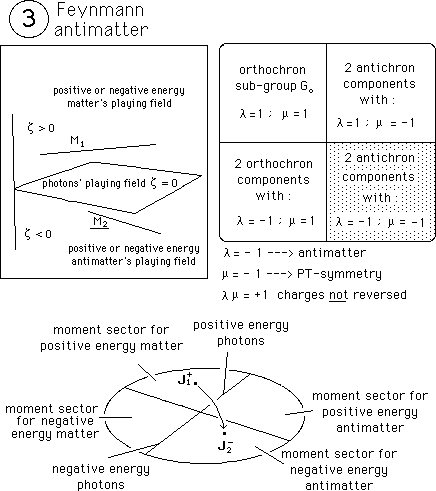
We get Feynmann anti-matter. But, as pointed out by Souriau in 1973, a PT-symmetrical particle goes backwards in time. Its mass and its energy are negative.
Remark : in this description the fact that the movement corresponds to positive or negative energy element does not appear in the evolution space (top-left).
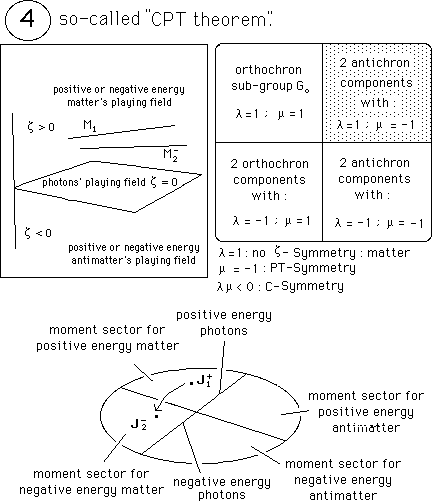
The last elements correspond to the sector ( l = 1 ; m = -1 )
( l = 1 ) --- > the movement is still in the matter's sector :
no z-Symmetry.
( m = -1 ) goes with a PT-symmetry. The particule runs backward in time.
( l = -1 ) : C-Symmetry. The charges are reversed.
...This is CPT-symmetrical matter, so that it corresponds to a geometrical interpretation of the so-called "CPT theorem", which asserts that the CPT-symmetric of a particle should be identical to that particle. That's not true. This movement corresponds to an antichron movement. The particle goes backward in time, si that (caodjoint action) its mass and energy become negative .
If CPT-symmetrical particle
do exist and if they collide normal particle, complete annihilation occurs.
(397)
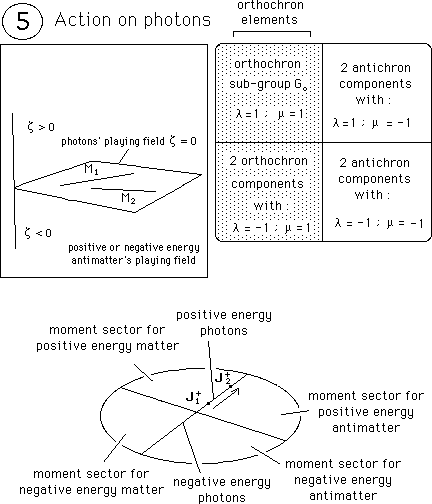
...The
coadjoint action of orthochron components modifies the movement and the moment
of the photon, but keep unchanged its energy.
(398)
(399)
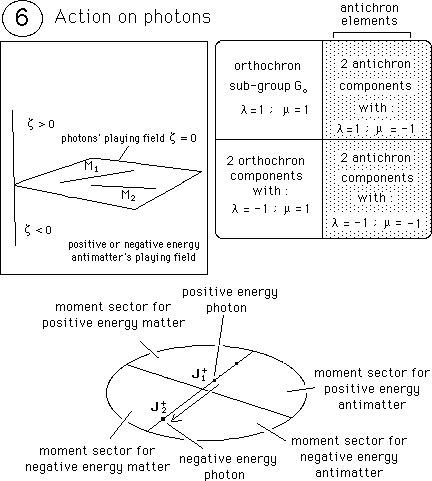
...We
see that reintroducing antichron components in the group arises PT-symmetric
anti-matter and CPT-symmetric matter. Both go backwards in time. Both come
from the action of an antichron element of the group on a normal matter movement.
Anti-matter is nothing but a peculiar movement . Same thing for
CPT-symmetrical matter which cannot be any longer identified to normal matter,
as classically asserted by so-called CPT-theorem, for the mass of a particle
which is CPT-symmetrical of a normal matter particle owns negative mass and
negative energy.
Similarly the Feynmann
antimatter owns a negative mass and nbegative energy ( while the Dirac's antimatter
own positive mass and energy ).