...Souriau notices the presence of resonant and non-resonants sub-systems. Both would correspond to stable configurations. The non-resonant configurations correspond to minimum energy exchange. The resonant configurations to maximum energy exchange (through dissipative tidal effect).
...One can ask : why both can exist in a same system and why the stability of the first comes from a minimum energy exchange, while this is the contrary for the second.
...A resonant configuration ( for an example the couple Neptun-Pluto ) can be assimilated to a Prigogine dissipative cell.
...Consider a pan
made of copper, with thick bottom, thick enough to store heat, like we find
in great restaurants. We warm it. Then we put water in it. Bénard cells
form, specially if the water depth is moderate. It is a dynamically stable
system.
(a717)
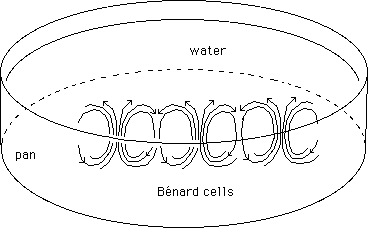
Schematically, this Bénard system forms a cellular
pattern made of hexagonal cells :
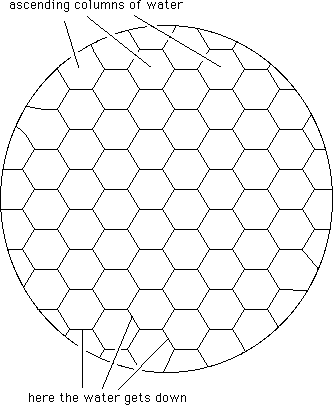
...We could destroy the Bénard celles, plunging in the hot matter a bees' cells structure, which would prevent the movement of the fluid. But, if we remove this gadget, and if the water is hot enough, the system of Bénard cells forms again immediatly, with similar distances bewteen the centers of the cells (characteristic wavelength of the phenomenon).
...This will be as long as the Bénard cells have good thermodynamical reason to exist. Later, when water will be cooled enough, they will disappear. Then, if we try to create such cells "artificially", with underwater fans, they will disappear when the fans are stopped. So that we have two distinct regimes.
...Bénard cells increase the dissipative process, bringing heat from the depth to the surface more efficiently than pure thermal conduction (with z = constant isothermal surfaces).
...When water is cooled enough the Bénard cells ar no more convenient. To be sustained they require too much energy, so that they disappear. The cooling of the water continues through another regime.
...The solar system is similar. We don't know how it formed. The origin of the solar system is still a great mystery.
...All that we know, or believe, is that dissipative process, through tidal effects, shapes it. It tends to build an ecliptic plan, a common plane in which all planets will run. In this plane, tidal effects tend to transform the trajectories into circles.
We have a lot of project for exploring that, through numerical simulations.
...From the analysis of Souriau, we can expect that the "golden law", corresponding to a non-resonant system, is the natural configuration a system of planets, or satellites, tends to.
The simpler system
- Planet
- Satellite
owns the following stable configuration :
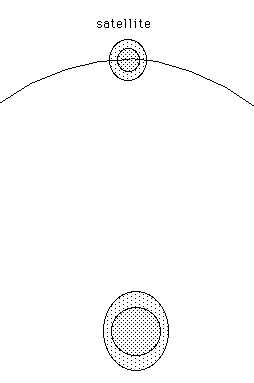
...When the period of orbitation of the satellite (the "Lunar month") is exactly the same as the "day" of the planet. The dissipative tidal effect tends to produce this configuration. In effect this is almost the case for Mercury, a planet which is the closest to the sun, and for Venus, whose heavy atmosphere undergoes an efficient tidal effect.
...At the contrary the day of the Earth is much shorter than the month of the moon (but notice that the Moon show always the same face to the Earth, which can be a consequence of dissipative tidal effect).
We get this :
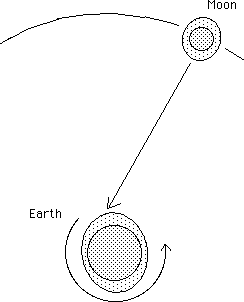
The Earth, which turns too fast, tends to pull the Moon. Two consequences :
1 - The orbital velocity of the Moon is increased. Its orbit'radius grows (few centimeters a year).
2 -This slows down the rotation of the Earth. The day was shorter in distant past.
For the couple Mars-Deimos the situation is inversed :
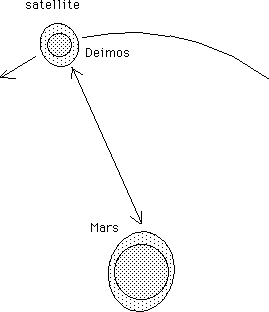
...Deimos runs too fast. The "month" of the satellite is much shorter that the day of the planet. Then Mars slows down its satellite, which tends to loose altitude. Conversely (but the effect must be very weak) the duration of Mars' day is shortened.
...It is expected that Deimos will fall on Mars within some 107 years. When the result of this two body interaction is not so catastrophic, it tends to the equalize the day of the planet and of the month of the satellite, if possible, of course.
...Tidal effect explains why the kinetic momentum of the solar system is mainly contained by its planets (mostly by the bigger one, Jupiter).
...Planets rotate around the sun. Then the "month" becomes the "year". A system with a single star and a single planet would tend to the equality of the "day" ( the rotation period of the star ) and ofthe "year" : the rotation period of the planet. If possible.....
...This is an ideal system. With a many planets system this becomes basically impossible. But the sun "turns too fast", with respect to his planets, so that these planets tend to slow its rotation. Conversely the Sun gives momentum to the planets, raise their orbitation velocity. Normally the would tend to slowly move away.